In October 2023, we announced sentencex — a sentence segmentation library built for the wide language diversity of Wikipedia and Wikimedia projects. The original release comprised two separate libraries: one in Python (used by MinT, our machine translation service) and one in JavaScript (used by Content Translation). Both were rule-based, practical, and got the job done.
But maintaining two implementations of the same logic was a constant source of drift.
sentencex 1.0 is a ground-up rewrite in Rust, with the Python and JavaScript libraries replaced by thin bindings over a single, shared core.
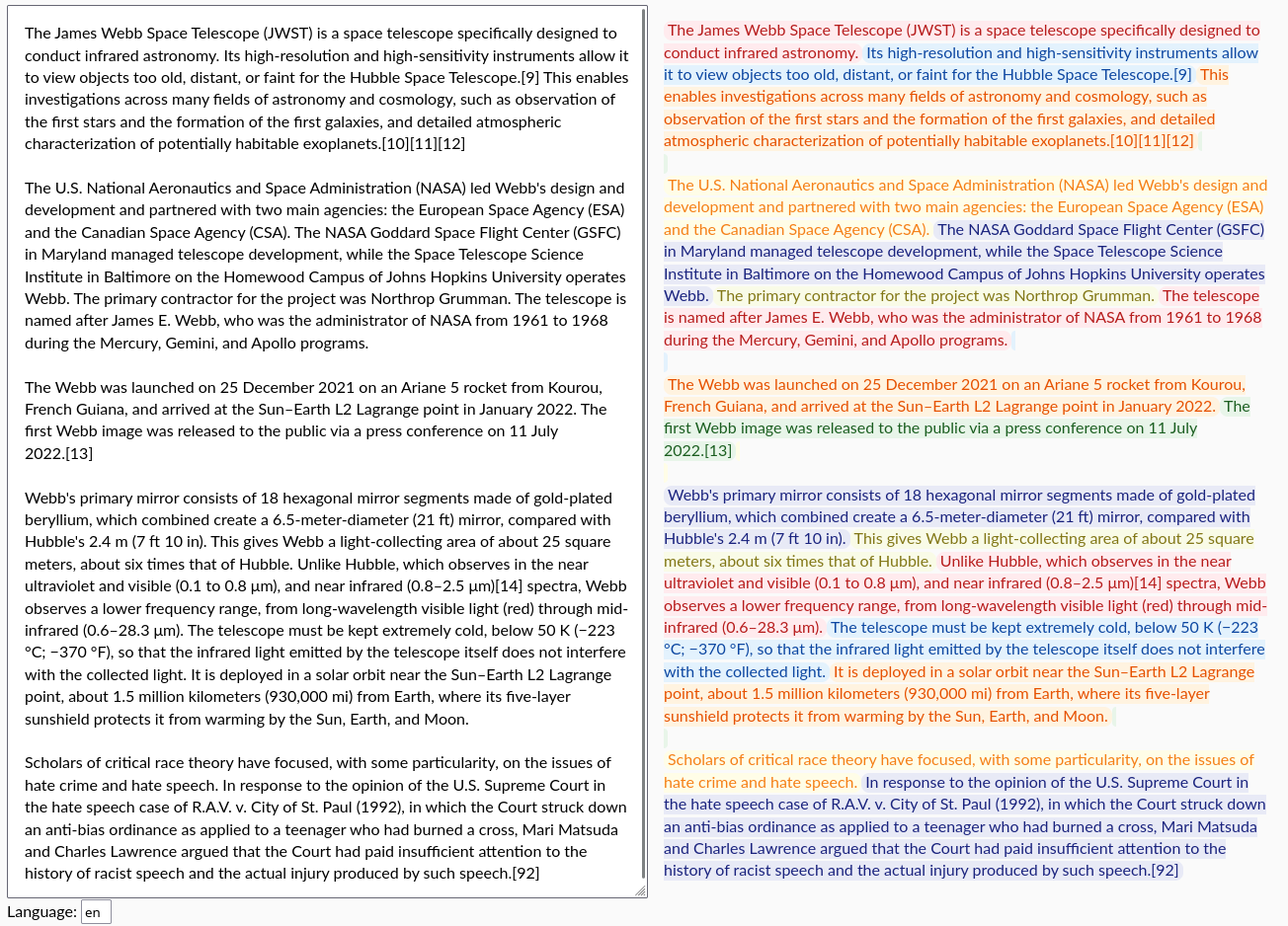
Screenshot of sentencex online demo
Why Rust
The original Python library took approximately 11 seconds to segment the Complete Works of Shakespeare — a 5.29MB plain-text file.
Old sentencex library
# /// script
# dependencies = [
#  "sentencex==0.6.1"
# ]
# ///
from sentencex import segment
import time

with open("shakespeare.txt") as bigfile:
    text = bigfile.read()
language_code = "en"
t = time.time()
sentences = segment(language_code, text)
time_taken = time.time() - t
print("Speed : {:>20.2f} ms".format(time_taken * 1000))
print(sentences)
uv run old-sentencex.py
Speed :             11058.93 ms
The Rust rewrite processes the same file in ~178 milliseconds.
$ curl https://www.gutenberg.org/files/100/100-0.txt | ./sentencex -l en > /dev/null
Time taken for segment(): 178.745108ms
Total sentences: 150254
That is roughly a 60× improvement. The output is the same 150,254 sentences — extracted correctly, non-destructively, with no allocations beyond the sentence boundary index.
Several design decisions drive this:
- Zero-copy output. The
segment()function returnsVec<&str>— slices pointing directly into the original input string. Nothing is copied or reallocated. - Static regex compilation. All regex patterns are compiled once at program startup via
LazyLockand reused across every call. - Chunk-based processing. For texts larger than 10KB, the library splits at paragraph boundaries, processes each chunk independently, and reassembles results. This keeps working-set sizes manageable and avoids pathological regex backtracking on long inputs.
- Compiled abbreviation lists. Abbreviation data is embedded at compile time via
include_str!, with no file I/O at runtime.
One Core, Three Platforms
The Rust library is the single source of truth. Bindings expose the same segment() and get_sentence_boundaries() API to Python, Node.js, and browser environments via WebAssembly.
Rust
cargo add sentencex
use sentencex::segment;

fn main() {
    let text = "The U.S. National Aeronautics and Space Administration (NASA) \
                led Webb's design and development. It launched in December 2021.";
    let sentences = segment("en", text);
    for sentence in &sentences {
        println!("{}", sentence);
    }
}
To process a file — say, the complete Shakespeare corpus:
use sentencex::segment;
use std::fs;
use std::time::Instant;

fn main() {
    let text = fs::read_to_string("shakespeare.txt").unwrap();
    let start = Instant::now();
    let sentences = segment("en", &text);
    println!("Segmented {} sentences in {:?}", sentences.len(), start.elapsed());
}
Python
pip install sentencex
import sentencex
import time

with open("shakespeare.txt") as f:
    text = f.read()

start = time.perf_counter()
sentences = sentencex.segment("en", text)
elapsed = time.perf_counter() - start

print(f"Segmented {len(sentences)} sentences in {elapsed * 1000:.0f}ms")
The get_sentence_boundaries() function returns structured data with byte offsets, useful for highlighting or annotation:
boundaries = sentencex.get_sentence_boundaries("en", text)
for b in boundaries:
    print(b["text"], b["start_index"], b["end_index"])
Node.js
npm install sentencex
import { segment, get_sentence_boundaries } from "sentencex";
import { readFileSync } from "fs";

const text = readFileSync("shakespeare.txt", "utf8");
const start = performance.now();
const sentences = segment("en", text);
console.log(`Segmented ${sentences.length} sentences in ${(performance.now() - start).toFixed(0)}ms`);
CommonJS:
const { segment } = require("sentencex");
Browser (WebAssembly)
npm install sentencex-wasm
import init, { segment } from "sentencex-wasm";

await init();
const sentences = segment("en", "Hello world. This is a test.");
Or directly from a CDN, with no build step:
import init, { segment } from "https://esm.sh/sentencex-wasm";
await init();
The WASM build exposes the same API as the native bindings. Running the Shakespeare corpus in a browser tab — all 5.29MB, 150,254 sentences — completes in around 200ms on a modern machine.
Language Support
The library ships with hand-curated rules for 30 languages: Amharic, Arabic, Armenian, Bengali, Bulgarian, Burmese, Catalan, Danish, Dutch, Finnish, French, German, Greek, Gujarati, Hindi, Italian, Japanese, Kannada, Kazakh, Malayalam, Marathi, Polish, Portuguese, Punjabi, Russian, Slovak, Spanish, Tamil, Telugu, and English.
For each of these, the library maintains:
- A list of known abbreviations (e.g.
Dr.,Prof.,Jan.for English;bzw.,z.B.,Mio.for German) - Language-specific sentence-break punctuation (e.g. Greek adds
;as a sentence terminator; Armenian and Burmese have their own terminators) - Override logic for edge cases like month names (German does not break after
Jan.when a date follows)
The Fallback Chain
Beyond the 30 directly supported languages, the library defines a fallback chain for ~244 language codes. Rather than silently falling back to English for an unsupported language, sentencex maps each code to the nearest linguistically related language that has custom rules.
Some examples:
| Requested code | Fallback chain |
|---|---|
de-at | de |
zh-cn | zh-hans → zh → zh-hant |
nb | no → nn |
tcy (Tulu) | kn (Kannada) |
blk (Pa’O Karen) | my (Burmese) |
als (Alemannic) | gsw → de |
The fallback map is built into a LazyLock<HashMap> at startup — zero runtime cost and no surprises. If a cycle is detected or no fallback exists, the library defaults to English.
The goal is to support every language with a Wikipedia edition. That currently means ~300+ language codes are handled, either directly or via the chain.
The Approach
sentencex uses a rule-based approach, not a statistical model. The core logic is:
- A period (or language-specific equivalent) ends a sentence.
- Unless the preceding token is a known abbreviation.
- Certain ranges are skippable: quoted text, parenthesized asides, email addresses.
This is deliberately conservative. When the library is uncertain — say, Albert I. Jones — it prefers not to split rather than splitting incorrectly. A missed boundary is usually less damaging than a false one for downstream tasks like text-to-speech or machine translation.
Segmentation is also non-destructive: the output slices are substrings of the original input. Joining all returned sentences reconstructs the original text exactly — whitespace, punctuation, and line breaks preserved.
Accuracy: The Golden Rule Set
Accuracy is measured against the English Golden Rule Set (GRS), a benchmark of 60 hand-labeled test cases originally assembled for pragmatic_segmenter. The cases cover abbreviations, quoted speech, parenthetical remarks, email addresses, numeric values, and more.
sentencex scores 100.00 F1 on this benchmark (list-format cases excluded):
| Library | English GRS F1 |
|---|---|
| sentencex | 100.00 |
| pysbd | 93.00 |
| blingfire | 91.67 |
| syntok | 85.67 |
| spacy | 81.67 |
| mwtokenizer | 78.00 |
| nltk | 72.33 |
The benchmark script is at benchmarks/compare.py and can be run with uv run benchmarks/compare.py. It tests both GRS accuracy and Shakespeare segmentation speed against all the above libraries.
A few illustrative cases from the GRS that the library handles correctly:
Input:  Her email is [email protected]. I sent her an email.
Output: ["Her email is [email protected].", " I sent her an email."]

Input:  She turned to him, "This is great." She held the book out to show him.
Output: ["She turned to him, \"This is great.\"", " She held the book out to show him."]

Input:  She works at Yahoo! in the accounting department.
Output: ["She works at Yahoo! in the accounting department."]
For the 5.2MB text file of Shakespeare’s works, blingfire from above list comes closer to sentencex. It takes roughly 3x as long as sentencex — about 500ms.
Blingfire speed test
# /// script
# dependencies = [
#  "blingfire"
# ]
# ///
```python
import blingfire

t = time.time()
result = blingfire.text_to_sentences(text)
sentences = result.splitlines() if result else []
time_taken = time.time() - t
print('Speed : {:>20.2f} ms'.format(time_taken * 1000))
print(  len(sentences))
print(  sentences)
Gives result like: Speed : 469.81 ms
Get It
- Rust: crates.io/crates/sentencex —
cargo add sentencex - Python: pypi.org/project/sentencex —
pip install sentencex - Node.js: npmjs.com/package/sentencex —
npm install sentencex - Browser/WASM: npmjs.com/package/sentencex-wasm —
npm install sentencex-wasm - Source: github.com/wikimedia/sentencex